1 Introduction
The Marine Sensitivity Toolkit (MST) is a cloud-native system developed for BOEM (Bureau of Ocean Energy Management) to assess the sensitivity of marine species to offshore energy development, whether oil & gas or wind. The Outer Continental Shelf Lands Act (OCSLA), Section 18(a)(2)(G), mandates that BOEM consider “the relative environmental sensitivity and marine productivity of different areas of the OCS” when planning the timing and location of offshore energy activities. The MST operationalizes this mandate by combining the best available species distribution data with extinction risk assessments to map areas of the ocean that are most sensitive to human activities.
The MST marks a significant advancement over prior RESA methodologies (Morandi et al. 2018). Earlier approaches often relied on aggregated data from a limited set of broad species groups and surrogate species, lacking spatially explicit information for individual organisms. As a result, previous assessments were typically coarse and areawide, frequently missing critical ecological variation and fine-scale patterns across the OCS. In contrast, the MST uses a high-resolution 0.05° grid (~4 km per cell) on a species level to capture fine-scale conservation concerns and ecological patterns across US waters.
The current system integrates 16,153 valid marine species across 7 source datasets, mapped at 0.05° resolution (~4 km cells) across the full US Exclusive Economic Zone (EEZ) study area; of these, 9,230 have modeled distributions that fall within the 20 BOEM Program Areas of the current program cycle. Species distributions are weighted by extinction risk scores that incorporate protections under the Endangered Species Act (ESA), Marine Mammal Protection Act (MMPA), and Migratory Bird Treaty Act (MBTA), as well as IUCN Red List assessments. The merged distribution of sensitivity per species is masked to expert ranges where available — species whose global range maps fall entirely outside the US EEZ are excluded, ensuring that only species with expert-confirmed presence in US waters contribute to scores.
This is a process, not a product. Information is imperfect, especially given the large expanse of US waters. Distributions and abundance of species change, modified increasingly by climate change and human activities. Knowledge on species sensitivities continues to expand with more research. Methods for both modeling and distributing this information continue to improve. In alignment with Executive Order 14303, we aim to provide a transparent and reproducible process that can be regularly updated as new data and methods become available.
1.1 Overview
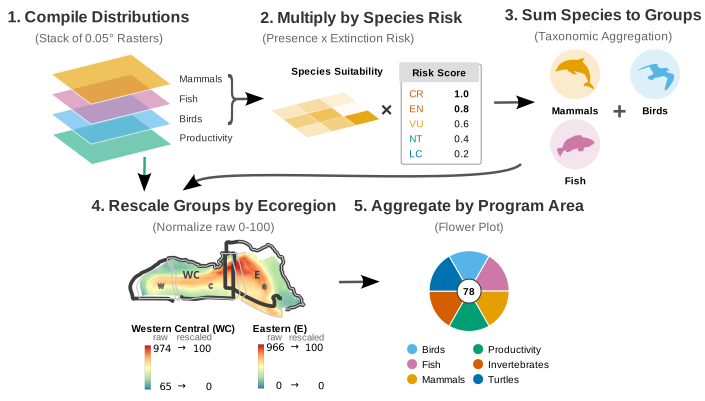
The MST analytical pipeline proceeds through the following stages (Figure 1.1):
- Data Sources: 7 source datasets of species distributions (AquaMaps SDM, NMFS Core Area, NMFS Critical Habitat, FWS Critical Habitat, FWS Range, BirdLife Range, IUCN Range)
- Taxonomy Matching: species names reconciled across WoRMS, GBIF, ITIS, IUCN, and BirdLife taxonomic authorities
- Model Merging: per-species models merged by taking the MAX suitability across datasets, constrained by IUCN/Critical Habitat spatial masks, with MMPA/MBTA spatial floors
- Cell Scoring: extinction risk weighted by species presence, summed by species category (bird, coral, fish, invertebrate, mammal, reptile/turtle)
- Ecoregional Rescaling: scores normalized to [0–100%] within each BOEM ecoregion for meaningful cross-region comparison
- Zone Aggregation: area-weighted averages to program areas, subregions, and ecoregions
- Visualization: interactive flower plots, treemaps, and map applications
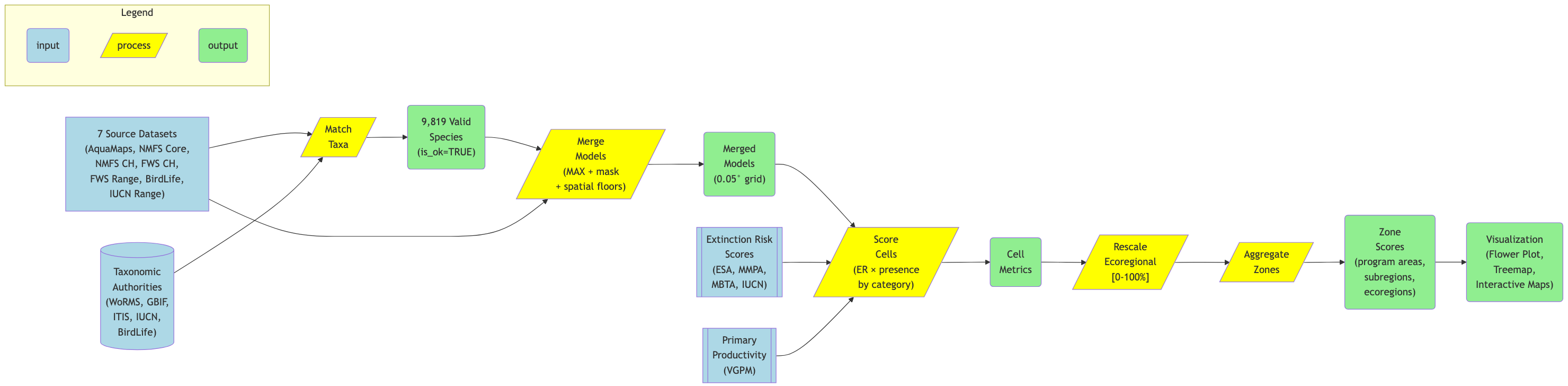
Figure 1.2 illustrates the full methodology at a glance. On the left, species distribution data flows in from 7 source datasets and 5 taxonomic authorities. In the center, models are merged per species and weighted by extinction risk scores derived from ESA, MMPA, MBTA, and IUCN regulatory frameworks. On the right, cell-level scores are rescaled within BOEM ecoregions and aggregated to program areas for visualization in the interactive mapping applications.